
The broken heart is a more eager vehicle for empathy where pain is a relay between the individual heart and the world of unknown misery so far away. The local and the global can leak towards each other when grief and sorrow meet an open heart. The proximate and immediate reel in suffering. No longer distant or merely imagined, we fish for each other in story and voice.
At least 33,686 Palestinians have been killed and 76,309 injured in Israeli attacks on Gaza since October 7. The death toll in Israel from Hamas’s October 7 attacks stands at 1,139, with dozens of people still held captive.
Al Jazeera 13 April 2024
Last Thursday morning, a friend invited me to a new Palestinian store that she had heard about on CBC radio. Considering the horrible news from Gaza and the West Bank, a trip to support a new local Palestinian business, seemed a good idea. The drive there was a bit confusing as it was quite far from the house and a bit challenging to get to. When we arrived inside, the walls sparkling with bedazzled embroidered gowns and tapestries. The owners of the store, a beautiful young Palestinian woman and her husband, were most welcoming and we talked for some time about the suffering in Palestine. Eventually I bought a golden kufiya, a colour she said the young people found fashionable. The colour reminded me of the sun I see so often here on the prairies. The same sun beats down on Gaza.
A few hours later, I stopped by the university to stand at their weekly half-hour silent vigil for Gaza that takes place on the University of Alberta campus. About a dozen people stood there at the same time as they had over the past six weeks or so. Several of them are old friends and colleagues and it felt good to see them and to stand with them. I had only just heard of this vigil which I was told wasn’t widely advertised as universities have been the site of such clashes over the past months. I introduced myself to a young man standing beside me who turned out to be a Palestinian graduate student from the West Bank. He showed me a video of his village where his family still lived, the rubble of the bombing that occurred the day before what was all that was left of the infrastructure after the Israel attack.
“They are destroying everything we need to live,” he said.
So much of Palestinian life has been destroyed by Israel since last October. We talked quietly about his intriguing thesis topic and I felt so sad about his life so far from his home, his family like so many imperiled there. I hope to see the student again soon.
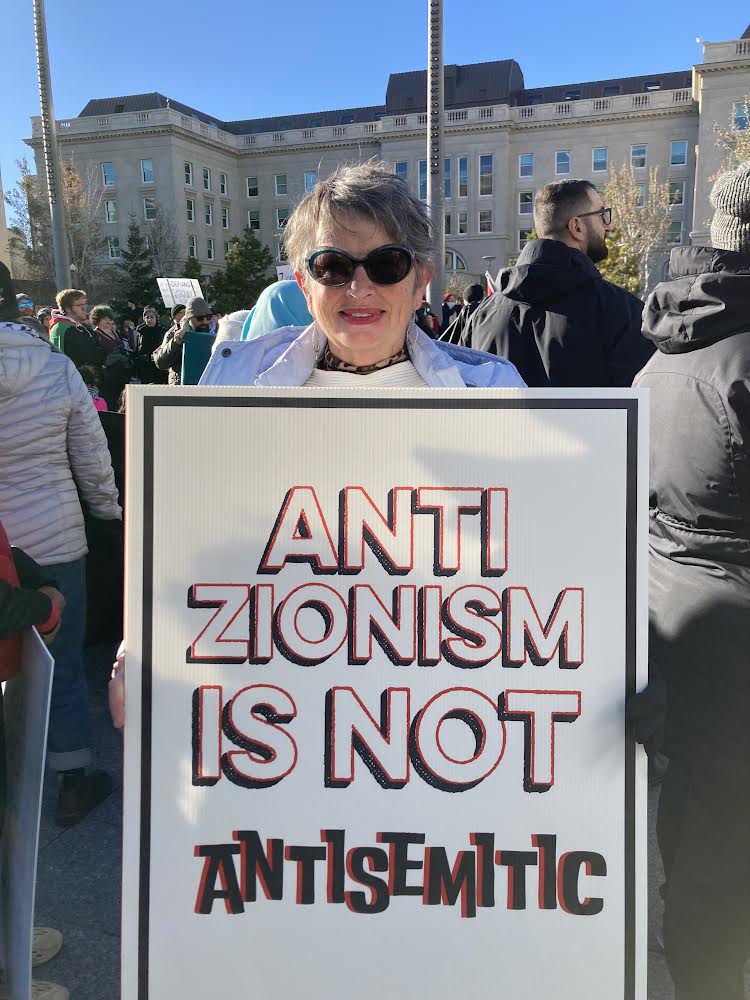
And here I feel compelled to add that Israel lost more than 1000 people on October 7 during the terrible attack, a war crime, that saw the kidnapping of hundreds of Israelis. Some have been returned home. But the hideous imbalance in the number of dead Palestinians since that time and the utter destruction of Gaza makes the case many times over for war crimes on the other side. It is hard to fathom Israel’s destructive path: the indiscriminate killings- 70% of them women and children, the destruction of more than half of the buildings, the deaths of journalists, medical personnel, aid workers, teachers, professors, the destruction of all of the hospitals, all of the universities, the religious buildings, the archives, etc. It is hard to fathom the facts.
I listen to an interview with Palestinian Swedish political scientist Abdilhadi Alijla who explains how Palestine has the most graduate degrees per capita in the world. And he notes that there is no childhood for children in Palestine. In searching for writing by this man, I found his short story that explores his sense of life in Palestine.
I opened my eyes to the world in a city with a lifeless childhood. I opened my eyes in the battlefield. Nobody told me who the soldiers were, or what occupation is.
I grew up having the idea of abnormality as what is normal, and that those persons who inflict fear whenever and wherever they go are not of our own.
When I opened my eyes to the world, I thought that young men and teenagers running away from the soldiers were playing hide and seek or practicing their hobby of playing catch.
I was wrong.
“Endgame” Abdilhadi Alijla
So far away, so near
As I write this the Ukrainian-Russia War is at a perilous moment with the isolationist wing of the GOP starving Ukraine of bullets and weapons as though the world outside could wait for their Trumpian excesses to subside. A recent visit by two Washington Post journalists tells us what is at risk as the Russian effort meets with success and Ukraine conserves their meagre military supplies using only two bullets to every 10 fired by the Russians.
The Ukrainian government recently extended the amount of time their soldiers can remain in the battlefield to ease the strain on finding new recruits to replace those killed in battle.
Meanwhile in a place where the Ukrainian population has long contributed to our city and province, recent migration from the war torn nation is evident in our neighbourhood and in workplaces nearby. The displacement of hundreds of thousands divides families and impoverishes them as well.
Meanwhile throughout the world, many more conflicts and wars kill many, often non-combatants. The cruelty of humans knows no bounds.

 No Gate No Lock